It could only be a Friday night when I write on a publicly viewable blog that I just had an Epiphanic moment in the shower with the use of a blue Bodyshop foot scrubber.
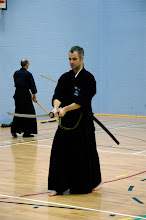
My last post was bothering me, I hadn't finished my thoughts on nukitsuke and the sayabiki/sayabanare moment. I could sense Peter West's fingers approaching his Mac keyboard to remind me of a continental-sized aspect I had missed in my argument. And then it came to me with the momentary use of a foot scrubber. I thought back to the video of Morishima Sensei doing an embu in Mierlo. I thought about how I tried to get some feeling into nukitsuke. I thought about all the photos of Japanese sensei in the pronounced moment of nukitsuke (in monochrome photos wearing montsuki).
The initial parts of the draw are done with the hands. During the moment of sayabanare the left and right hands "talk" to each other to communicate when and when the kissaki is to be released and has been released (that sentence wasn't a typo by the way). And now the bombshell; the sayabanare is done with the hands but the final sayabiki is done with the upper body....
...you knew that already!?
Well, if you did then I guess that just says that I have just acknowledged it in my blog.
Anyway, that's the feeling that was missing in my observations, that was why their kissaki's were too wide of the mark at the end of the draw, that's why the moment was being lost.
...and this is why I think that swords which are too small are a bad thing...
Saturday, 19 March 2011

Friday, 18 March 2011
Iaido Training Session 50
Standing on the shoulders of....other dojo members
Woot, made it to 50 sessions and my arms haven't fallen off yet. Wednesday and the couple of days following makes me realise how grateful I am to be part of a dojo filled with people who are willing to listen to my vague feedback to them about their iai, not really helping them at all, just so I can meditate on what was bothering me for the next 2-3 days. I'm sure once I am older and more dribbly that they will have their vengeance, like putting earwax into my liquidised food, but for now they happily exist as petrie dishes for my thought experiments and directionless mutterings and my development to 6th and the end of rational thought.
My teacher told me about one year ago that my Iaido training had to move it's focus away from the "What" and onto the "When". This post is devoted to that thought.
We expanded our abstract order training of seitei to 3 forms each this week (wow) and with no direction of what, where and when any emphasis should be placed. We then separated into free practice, Harry and me doing Chuden and the others doing seitei bits and pieces.
I was now caught and bothered by Lucy and Aurelien's nukitsuke from Mae. I couldn't help noticing that the sword was coming out a little too directly and easily and with little sayabanare going on. I spent a bit of time explaining how sayabiki converts into sayabanare at the moment of release of the kissaki from the saya. This in itself is a difficult thing to time. It is necessary, especially in Muso Shinden Ryu, to not finish the final sayabiki until the sword is actually cutting into the nukitsuke. This is of course quite a small movement with the saya compared to the larger movement of the sword and one can either make the saya move in slow motion (which then lacks any sharpness to the movement) or moderate the earlier part of the movement into a final acceleration. Tricky indeed. Suffice to say, the entire control of the left hand on the saya is a complex one. I have tried to simplify the action in the diagram below:

This implies (and correctly I believe) that sayabiki comes and goes a little bit or rather, it's speed is modulated during the nukitsuke action.
But looking deeper into this point, this is what I think: that at the moment where the decision is finally made to draw the sword, this is the point where you are most likely to die.
By this I mean that this must be the final moment, where the enemy's attempt to attack is maximised and is thus the most dangerous point for you. The Seitei manual describes this in the line "kisen o sei shite [komekami] ni nukitsuke" or "seize the moment of opportunity and draw to the opponent's temple". I think this "seizing of the moment" is an important point to express in one's kata if we are attempting to import Katsujinken (the sword that saves or wins) into what would otherwise be Setsuninto (the sword that kills). I also believe that whether one intends to allow the opponent to live or not, the moment of this decision needs perceiving, living and tempering . It is a moment where one has decided to kill. It is also the moment that you are about to die.
It reminds me of a nice proverb which reads quite well in Japanese:
勝利の瞬間
兜の绪を締め
Shori no shunkan
Kabuto no himo wo shime
At the moment of victory
Tighten the helmet straps
The meaning of this of course is that the very moment of victory is the moment when the opponent is at their most dangerous and you are most likely to lose. Perhaps instead of the Seitei manual saying about "seizing the moment" that the phrase "squeezing the moment" would be more appropriate.
From a practical point of training, I am pretty sure that at a high level the only way to actually see this moment would be through looking at a slow-motion video, however if the sword is merely accelerating out of the saya with no point of tame then clearly this moment does not exist. In fact I think that the setting of the front foot position is probably just the second where this moment exists.
Anyway, after watching the others go through considerable pain to analyse and change what they were doing I encouraged them to play around with the various versions of Koranto to lightent the moment somewhat. Hopefully that will make them hate me less.
Woot, made it to 50 sessions and my arms haven't fallen off yet. Wednesday and the couple of days following makes me realise how grateful I am to be part of a dojo filled with people who are willing to listen to my vague feedback to them about their iai, not really helping them at all, just so I can meditate on what was bothering me for the next 2-3 days. I'm sure once I am older and more dribbly that they will have their vengeance, like putting earwax into my liquidised food, but for now they happily exist as petrie dishes for my thought experiments and directionless mutterings and my development to 6th and the end of rational thought.
My teacher told me about one year ago that my Iaido training had to move it's focus away from the "What" and onto the "When". This post is devoted to that thought.
We expanded our abstract order training of seitei to 3 forms each this week (wow) and with no direction of what, where and when any emphasis should be placed. We then separated into free practice, Harry and me doing Chuden and the others doing seitei bits and pieces.
I was now caught and bothered by Lucy and Aurelien's nukitsuke from Mae. I couldn't help noticing that the sword was coming out a little too directly and easily and with little sayabanare going on. I spent a bit of time explaining how sayabiki converts into sayabanare at the moment of release of the kissaki from the saya. This in itself is a difficult thing to time. It is necessary, especially in Muso Shinden Ryu, to not finish the final sayabiki until the sword is actually cutting into the nukitsuke. This is of course quite a small movement with the saya compared to the larger movement of the sword and one can either make the saya move in slow motion (which then lacks any sharpness to the movement) or moderate the earlier part of the movement into a final acceleration. Tricky indeed. Suffice to say, the entire control of the left hand on the saya is a complex one. I have tried to simplify the action in the diagram below:

This implies (and correctly I believe) that sayabiki comes and goes a little bit or rather, it's speed is modulated during the nukitsuke action.
- Sayabiki is first used to facilitate the removal of the saya from the sword.
- Sayabanare accentuates the release of the kissaki from the koiguchi and provides impetus for the sword to travel forwards.
- Sayabiki is finally used to emphasise the cutting action of the nukitsuke (whether or not one actually cuts or merely subdues is based on opinion).
But looking deeper into this point, this is what I think: that at the moment where the decision is finally made to draw the sword, this is the point where you are most likely to die.
By this I mean that this must be the final moment, where the enemy's attempt to attack is maximised and is thus the most dangerous point for you. The Seitei manual describes this in the line "kisen o sei shite [komekami] ni nukitsuke" or "seize the moment of opportunity and draw to the opponent's temple". I think this "seizing of the moment" is an important point to express in one's kata if we are attempting to import Katsujinken (the sword that saves or wins) into what would otherwise be Setsuninto (the sword that kills). I also believe that whether one intends to allow the opponent to live or not, the moment of this decision needs perceiving, living and tempering . It is a moment where one has decided to kill. It is also the moment that you are about to die.
It reminds me of a nice proverb which reads quite well in Japanese:
勝利の瞬間
兜の绪を締め
Shori no shunkan
Kabuto no himo wo shime
At the moment of victory
Tighten the helmet straps
The meaning of this of course is that the very moment of victory is the moment when the opponent is at their most dangerous and you are most likely to lose. Perhaps instead of the Seitei manual saying about "seizing the moment" that the phrase "squeezing the moment" would be more appropriate.
From a practical point of training, I am pretty sure that at a high level the only way to actually see this moment would be through looking at a slow-motion video, however if the sword is merely accelerating out of the saya with no point of tame then clearly this moment does not exist. In fact I think that the setting of the front foot position is probably just the second where this moment exists.
Anyway, after watching the others go through considerable pain to analyse and change what they were doing I encouraged them to play around with the various versions of Koranto to lightent the moment somewhat. Hopefully that will make them hate me less.
Monday, 14 March 2011
Kiyome and the Flow of the Ryuha
Some part of me is hesitant to write about this particular subject as my thoughts on it sit more comfortably with Jodo than with Iaido. Why is this? Iaido, by it's nature where the effectiveness of technique is sometimes difficult to test, generally tends to be far more detailed and technically strict in it's teachings. Jodo, on the other hand, while not lenient in the area of technical correctness, is more forgiving in it's allowances for personal physical interpretation providing the effectiveness of technique is convincing. It is not the absence of flexibility in Iaido which makes me reluctant to write this in an iai context but rather the tendency towards uniformity. Perhaps if I didn't do Jodo I wouldn't feel the same way. Anyway, getting on...
I want to reflect on some thoughts I had while flying to Poland recently and getting towards the end of the book "Last Chance to See" by Douglas Adams and Mark Carwardine. Those of you who have read it or are familiar with Douglas's works will know that the book is an account of their project to see and record species which are approaching extinction. In one part of the book Douglas recounts an earlier visit to Japan where he had the occasion to see Kinkajuji, the temple of the golden pavillion in Kyoto. His tour guide informs him that the building dates back to the 14th century. Douglas mentioned that it was incredible that a building so old should continue to look so spectacular. The tour guide responded that the building itself had been rebuilt numerous times, sometimes because of fire, sometimes because of general degradation. Douglas challenged the tour guide on this saying that surely then this isn't the original building. "Oh yes, it's the same building. Exactly the same as from the 14th century and it's been rebuilt many times." Douglas concludes, quite nicely in the book, that this is a contrast in the way of thinking between the East and the West. In the West we tend to attribute the permanence and age of a building by it's physical materials in the walls, the pillars, the bricks, the roof, the floors etc. In Japan at least, the building is a manifestation of a design, an intended use, an image that an architect may have dreamed up. No permanance or nature is given to the materials of the building itself. The building lives and exists through it's form through design and it's use.

This is connected to the tradition and process of "Kiyome" or purification. Whole shrines and temples are dismantled and their materials renewed. Much work goes into ensuring that the "new" building matches the previous design as closely as possible. Often the work is carried out with the assistance of the monks and priests of the site. We might interpret this as refurbishment when it comes to buildings but this is a skeletal image of what actually happens. Through this process the building is regenerated, given a fresh life and most of all, purified but loses none of the original dream of the designer.
The underlying principal in all this is that the nature of the temple or the shrine is in "the intention of the architect" and this is a phrase I would like to use when thinking about how kata must inevitably vary as they are passed from generation to generation, from varying physical body to varying physical body, from personal mind to personal mind. Where experiences and the environment change the visible material of the kata. So what is the Ryu if the "software" goes through such inevitable change? Surely only the intention of the architect.
To explore this further perhaps it is important to make distinction between the two "tendencies" of kata with regards to Iaido. In one extreme, a kata may have been the result of an actual combatitive experience and the survivor of this experience may have thought that what action actually saved the day was worthy of preserving and teaching to others. In this sense, the technique is a wholly practical one and is the response to a certain situation. This might be referred to as a "Jokyo Kata" (situational kata). In the other extreme, an experienced swordsman might have recognised that certain "exercises" in technique, timing and movement within a mental context would facilitate the creation of a well-rounded martial artist where nearly any situation might call upon the range of well developed techniques to save the exponent. These are referred to as "Toho Kata" (sword methodology kata). Some people actually divide kata up into these two category; some consider all kata in a style to be either one or the other; some consider that all kata are Toho but have to be learned through the context of Jokyo, the latter of which should be essentially cast aside as soon as it's use subsides. I fall into that category of people who believe that the last interpretation is the most accurate.
In any case, even with the most attentive of soke of a style, change is inevitable in a ryuha. While we may spend sleepness nights worrying about this (or not) I believe the grace of it all is in believing that each stage of a kata being passed from one person to another is another phase of Kiyome, of ritual purification where the architect's intent is transmitted and the materials renewed. In this case it is not realistic for a teacher to assume that even the best student should produce a carbon copy of his taught form. By passing a kata from an elderly teacher to a younger student, the kata may become invigorated with youthful energy. It may lack some of the smoothness of well trod wooden floor boards but provided the architect's intentions are preserved, Kiyome has taken place without detriment to the design.
A good example of this is the contrast between Ishido Sensei and his main student Morishima Sensei. The two of them are separated by about twenty years in age, Morishima is a bit taller than Ishido Sensei. Their koryu are slightly different, the former being quick and light, the latter being large and vigorous. You can see slight variations in their delivery of form and often one will favour a different kaewaza to another but the similarities are very deep. You can see how Morishima Sensei has embedded critical factors taught to him by his own sensei but which have been smoothed and moderated by the elder. Even greater contrasts are obviously visible between Ishido Sensei and his European Monjin where body build, transmission variances and lifestyle differences have created sets of interesting variations, each containing some aspect of Ishido Sensei and all with a larger or lesser emphasis.
Maybe this is what we judge when we observer others' performance. Some will be able to display the architect's intentions very clearly, some will have more subtle and smoother features to be viewed. Some, who have misinterpreted or never understood the intentions, might be viewed with critical eyes regardless of how vigorous, strong or fast they are. Lucy Earley explained to me recently that Ishido Sensei performs the draw in Batto/Nukiuchi quite slowly and smoothly these days. He used to show off a bit with how quickly he could do this draw. Both ways of making this sudden draw are surely valid, one fast to the point of being invisible, one so smooth and subtle that it is unnoticeable and thereby it's a fine, fine thing that Iaido is available to everyone regardless of their strengths or limitations.
I do not imagine for a minute that I will ever be able to do Iaido as well as or better than Ishido Sensei but maybe in trying to replicate his splendid halls of stone, my brick-built toilet block will suffice...
I want to reflect on some thoughts I had while flying to Poland recently and getting towards the end of the book "Last Chance to See" by Douglas Adams and Mark Carwardine. Those of you who have read it or are familiar with Douglas's works will know that the book is an account of their project to see and record species which are approaching extinction. In one part of the book Douglas recounts an earlier visit to Japan where he had the occasion to see Kinkajuji, the temple of the golden pavillion in Kyoto. His tour guide informs him that the building dates back to the 14th century. Douglas mentioned that it was incredible that a building so old should continue to look so spectacular. The tour guide responded that the building itself had been rebuilt numerous times, sometimes because of fire, sometimes because of general degradation. Douglas challenged the tour guide on this saying that surely then this isn't the original building. "Oh yes, it's the same building. Exactly the same as from the 14th century and it's been rebuilt many times." Douglas concludes, quite nicely in the book, that this is a contrast in the way of thinking between the East and the West. In the West we tend to attribute the permanence and age of a building by it's physical materials in the walls, the pillars, the bricks, the roof, the floors etc. In Japan at least, the building is a manifestation of a design, an intended use, an image that an architect may have dreamed up. No permanance or nature is given to the materials of the building itself. The building lives and exists through it's form through design and it's use.

This is connected to the tradition and process of "Kiyome" or purification. Whole shrines and temples are dismantled and their materials renewed. Much work goes into ensuring that the "new" building matches the previous design as closely as possible. Often the work is carried out with the assistance of the monks and priests of the site. We might interpret this as refurbishment when it comes to buildings but this is a skeletal image of what actually happens. Through this process the building is regenerated, given a fresh life and most of all, purified but loses none of the original dream of the designer.
The underlying principal in all this is that the nature of the temple or the shrine is in "the intention of the architect" and this is a phrase I would like to use when thinking about how kata must inevitably vary as they are passed from generation to generation, from varying physical body to varying physical body, from personal mind to personal mind. Where experiences and the environment change the visible material of the kata. So what is the Ryu if the "software" goes through such inevitable change? Surely only the intention of the architect.
To explore this further perhaps it is important to make distinction between the two "tendencies" of kata with regards to Iaido. In one extreme, a kata may have been the result of an actual combatitive experience and the survivor of this experience may have thought that what action actually saved the day was worthy of preserving and teaching to others. In this sense, the technique is a wholly practical one and is the response to a certain situation. This might be referred to as a "Jokyo Kata" (situational kata). In the other extreme, an experienced swordsman might have recognised that certain "exercises" in technique, timing and movement within a mental context would facilitate the creation of a well-rounded martial artist where nearly any situation might call upon the range of well developed techniques to save the exponent. These are referred to as "Toho Kata" (sword methodology kata). Some people actually divide kata up into these two category; some consider all kata in a style to be either one or the other; some consider that all kata are Toho but have to be learned through the context of Jokyo, the latter of which should be essentially cast aside as soon as it's use subsides. I fall into that category of people who believe that the last interpretation is the most accurate.
In any case, even with the most attentive of soke of a style, change is inevitable in a ryuha. While we may spend sleepness nights worrying about this (or not) I believe the grace of it all is in believing that each stage of a kata being passed from one person to another is another phase of Kiyome, of ritual purification where the architect's intent is transmitted and the materials renewed. In this case it is not realistic for a teacher to assume that even the best student should produce a carbon copy of his taught form. By passing a kata from an elderly teacher to a younger student, the kata may become invigorated with youthful energy. It may lack some of the smoothness of well trod wooden floor boards but provided the architect's intentions are preserved, Kiyome has taken place without detriment to the design.
A good example of this is the contrast between Ishido Sensei and his main student Morishima Sensei. The two of them are separated by about twenty years in age, Morishima is a bit taller than Ishido Sensei. Their koryu are slightly different, the former being quick and light, the latter being large and vigorous. You can see slight variations in their delivery of form and often one will favour a different kaewaza to another but the similarities are very deep. You can see how Morishima Sensei has embedded critical factors taught to him by his own sensei but which have been smoothed and moderated by the elder. Even greater contrasts are obviously visible between Ishido Sensei and his European Monjin where body build, transmission variances and lifestyle differences have created sets of interesting variations, each containing some aspect of Ishido Sensei and all with a larger or lesser emphasis.
Maybe this is what we judge when we observer others' performance. Some will be able to display the architect's intentions very clearly, some will have more subtle and smoother features to be viewed. Some, who have misinterpreted or never understood the intentions, might be viewed with critical eyes regardless of how vigorous, strong or fast they are. Lucy Earley explained to me recently that Ishido Sensei performs the draw in Batto/Nukiuchi quite slowly and smoothly these days. He used to show off a bit with how quickly he could do this draw. Both ways of making this sudden draw are surely valid, one fast to the point of being invisible, one so smooth and subtle that it is unnoticeable and thereby it's a fine, fine thing that Iaido is available to everyone regardless of their strengths or limitations.
I do not imagine for a minute that I will ever be able to do Iaido as well as or better than Ishido Sensei but maybe in trying to replicate his splendid halls of stone, my brick-built toilet block will suffice...
Subscribe to:
Posts (Atom)

 Posts
Posts