Well, not exactly. But I did discover a document that I started in 1997, about a year after I moved back to the UK from Japan. I have pasted the contents of it here, for a bit of a laugh really. I might continue it later when I have some more time but for now, please enjoy all the writing skill of a 26-year old electrical engineer...
A Study of Japanese Budo
My first experience of martial arts actually in Japan was not a very good one. I was invited to observe a training session at a karate dojo of the Mushinkan style. It was disappointing and was nowhere near as good as the shotokai style that I was doing at home. The attacks were lifeless and the defences were unrealistic.
Upon my second coming to Japan for work purposes, I made it known that I was interested in practising the more ancient and traditional of martial arts (karate of course not being actually of Japanese origin).
A couple of months passed before I was introduced to an ex-employee of the company I was working for. He was an elderly man of about mid-sixties and he had a kind smile and gentle atmosphere about him. His name was Mr. Yoneya and he was an iaido sensei in Yokohama. He had been told about my interest from one of my colleagues and invited me to join the martial arts federation that he belonged to. If so then he would introduce me to a teacher in Narita. I said yes and he said that I would have to buy the training suit and a practise sword before I began. In a weeks time I was visited by a stockist who Yoneya-sensei had contacted and I purchased a black, extra long jacket, hakama and obi. My next visit was with Yoneya-sensei from a sword dealer. Yoneya-sensei recommended a sword and I bought it for about 200 pounds. This too was extra long to account for my height.
I was now ready to attend a training session. I went along to Narita Police Station where the dojo was located and went up to the third floor. I went in and removed my shoes and after bowing entered the dojo. It was there where I was greeted by the man who would be my master of training for the time I was practising. His name was Noguchi-sensei, a short plumpish man who although was sixty-three, stills looked mid forties. He welcomed me in and I was introduced to another sensei Wada-sensei.
Wada-sensei showed me how to wear the dogi and I was then taken aside and shown the basics of iaido on the tatami mat.
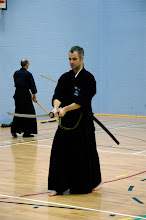
Iaido is the Japanese martial art of drawing the sword. It is practised alone in katas and consists of the initial draw which is usually a cut or a parry followed by a downward strike. After the enemies have been dispatched there follows chiburi, the flick of the sword to remove blood from the blade and then noto, the replacement of the blade in the scabbard in a smooth stroke. Throughout all this, the exponent maintains concentration, never allowing his attention to waver, always focused on the cut and his enemy.
The first training session was painful as the basic moves required to start off in seiza, sitting on the haunches which is easy for Japanese who are accustomed to it but not so easy for Westerners who are used to sitting on chairs. The major cutting action also required one to be positioned on one knee with the other leg projected forward to support the body. On top of all this was the rather heavy sword which was very difficult to wield properly. The blade has a blood line carved in it which causes the sword to whistle is a cut is made properly that is with the edge aligned with the direction of the cut. It was, needless to say, very difficult to get my sword to whistle.
By the end of the first lesson, Noguchi-sensei had managed to teach this clumsy foreigner how to carry out the basic first kata. By the end of the iaido lesson, the small dojo had filled up with about ten other members including Fujita-sensei, the head teacher at this dojo and the contact with Yoneya-sensei. The iaido class finished and I saw that they were preparing to train with the Japanese four foot long staff, the jo in the art named jodo. While training in karate in England, I had taken an interest in jodo but having no sensei I had to self train myself in aikijo, the aikido syllabus of jodo from a book. Thereby I had for a long time looked for a jodo sensei and here they were.
I expressed my interest in doing jodo and Noguchi sensei took me into my first jodo lesson. This was far more easy than iaido especially as the techniques are carried out from a standing posture. There were also basic techniques that I could practise which made it very similar to karate training. I learned the basic strike, the reverse strike and how to move while carrying out these strikes. I think that in the same lesson, Noguchi-sensei also taught me the basic and reverse hand thrust as well as the two types of kiai. The lesson finished and one of the trainees lent me his jo for me to train at home. I thanked them and left with a great feeling of accomplishment. I had completed my first lesson in the art of Japanese budo.
In the following lessons I was taught up to the third kata of iaido and jodo as well as other basic techniques of jodo. The jodo was easy. There were basic techniques and the katas which are done in pairs, the jo against the bokken, the wooden sword, gave me a chance to appreciate the effect of the techniques and gave one the feeling of actually learning to fight. My iaido however was not so hot. The first three katas, all being sitting katas, caused me no end of problems. My legs would hurt so much that by the time I came round to carrying out the kata, my legs would wobble and would throw off my arm action. From my karate training I knew that somewhere I was supposed to concentrate on an imaginery enemy but my mind was struggling to control my arms and legs and head and posture and so on and so on. Much of the kata also required single arm control of the sword and this would also prove to be difficult. The sword seemed too long and unwieldy. It would wobble around or droop where it was supposed to remain level and the main strike would throw my whole posture off balance and forward. I gradually began to lose interest in this art which would probably be of no use in a real fight and was too difficult for me. I subsequently paid less attention to iaido and threw my efforts into practising jodo.
Was this the wrong thing to do, I ask myself. Looking back now, I think not. For me, trying to balance two very different (although in fact very strongly related) martial arts might have caused me to drop both of the trays of drinks and just caused me to become even less accomplished of both arts. I think now about how as a beginner, the training resembled climbing a ladder. You have to move one arm at a time and one leg at a time. If you try to move both right and left simultaneously then you fall off the ladder. If this is a poor excuse then I am afraid it is the only one I have. Later this would change though.
The fact that I only knew three katas created boredom with iaido and fed my lethargy. I was then lucky enough to spend a single training session with my future jodo training partner, a twenty three year old guy called Kawasei-san. He was a third dan at iaido and was thereby very accomplished at his art especially for such an early age. By tackling one problem (opportunity) at a time he taught me a further three katas. The fourth kata in the series was from a half sitting position and although this posture was even more painful, the fact that the kata contained a thrust, two opponents and a much easier chiburi (flicking blood from the sword) made it much more attractive than the basic three. The fifth and sixth were standing/walking katas and were also very dynamic and interesting.
In the next few months, after purchasing a very good book on iaido by Donn Draeger, I was able to learn all ten of the iaido introductory katas. This gave me a nice little syllabus to train with but around this time my jodo training became even more interesting with long and flowing katas with an opponent and my iaido training suffered again. I was soon brought back in line by Noguchi-sensei, not by expanding my iaido training but by restricting my jodo training to the first three katas. I was dismayed. I would be training with a higher grade reaching more and more advanced katas and Noguchi-sensei would come along and tell him only to train with me in the first three. What did he think he was doing? I began to suspect that the stories of Japanese teaching foreigners benign martial arts might be true. I could, at that time, see no advantage in restricting the katas I was training. I was angry and hammered out those three katas continuously. Each session, the instructors would correct a tiny detail to the katas and I would feel the need to move on to more advanced training. Surely this level of detail was enough!
My first jodo grading was approaching and this was preceded by a weekend training course or gasshaku, near the sea. I imagined that this was my chance to really get some advanced training. A whole weekend of jodo! Surely an opportunity not to be missed. By this time, Kawasei-san and I had been established as training partners, not only because we were the same grade but also we were similar heights. It was a pleasure to train with him. He was a modest gentleman with no expanded ego but also with a similar hunger for learning as I had. I sometimes felt though that he lacked an aggressive spirit and the katas seemed to lack feeling. I wanted to feel a clash of opponents and the atmosphere of fighting for life. It was sometimes difficult to get this from him. I wanted him to hurt me when he won the jo kata and I wanted him to attack me ferociously when he attacked with the bokken. For that slight lack in spirit he made up for it a thousand times by his extreme patience which exceeded mine by miles.
We went to the training course and I was again thrown into a silent rage by being instructed by Noguchi-sensei only to train in the first three katas and basic techniques. This was, he explained, because the grading test only required for me to be tested in these six elements. But surely, I thought, we know these things very well now and it was time to move onto higher things in preparation for future gradings. I also thought that the grading was not so important for me. My ambition was to learn as much as I could in the limited time I had in Japan. I thought my learning was being held back. How stupid of me as I was soon to learn.
The training session finished and we went home, Kawasei-san's and my kata having changed considerably during the course. At the end we were made to do a dummy run for the grading and everyone said we did very well but I was looking at the advanced trainees as they worked through the higher, longer and far more exciting katas.
The grading arrived. We went to the Prefectural training dojo and had a final intensive morning course with the sensei from the jodo headquarters. Our 'ikkyu' (first grade) group of four learned many things about the meanings of the techniques we were learning. The afternoon came and we did the grading under the watchful eyes of the examiners. I felt that I had to "play dead", that is to ignore everything around me and do the katas with Kawasei-san like it was any other training session.
After we finished we sat down and watched the first dans doing their grading. This was where the relevation came. We watched and I think that Kawasei-san had the same feeling, the first dan group (who mostly were not under the tutelage of Noguchi-sensei having coming from other dojos) were carrying out their katas with a noticeable lack of tidiness and sharpness. At least that was how it looked. To a complete beginner they probably would have looked very ordered, but to me, I saw dozens of mistakes that had been ironed out of my partner and I. Sometimes it was laughable. I can imagine members of the general public trying to do marching practise like soldiers and that is how the first dans looked to me. It was sloppy. This opinion was backed up by two other of my senseis, one of them, Takeuchi-sensei who is an English teacher, said that our kata was far superior to the first dan's. After the first dans had finished, our ikkyu group was told that we had all passed and well done. We then watched some of the higher grades doing their test. This was, of course, much better but at one point, one of the senior senseis lost his way through a kata. He then made the same mistake again. It was a little bit pitiable to watch but I felt slightly justified in thinking that if he had trained then he would have passed. It was a very superior way of thinking and I scorn myself now for being so arrogant.
After this grading session I could see the firm reasoning in Noguchi-sensei's order for us to limit our training. To pass the test would have been easy. He wanted us to pass it with flying colours. Everything negative I had thought about his order in the past I could now see was unjustified. Perhaps the first dans in the class above us would continue to learn their katas sloppily until one day, at a high level grading course, they would fail because the quality was not good enough. Noguchi-sensei had however instilled something in us that could never fade. The intensive training in the first three katas would, I hope, shine through the rest of the katas. We would train in every kata until they were the same quality as the first three or even better. This is not to say that I have learned all there is to these basic katas. Far from it, in fact every time I train in jodo, I am corrected on a small point. This is especially true where the problem lies in finding inner power. This occurs when the jo is locked in a parry with the wooden sword. Here, it is important not to tense the shoulders and upper body but to sink the power and rely on that energy called ki that is so widely expressed in the martial arts. I have been told many times that I should release the power in my shoulders into the technique and then that power can flow to my benefit but I am not yet able to do even this yet. I find myself fairly well thrown by my seniors who are of a lesser build than me with no apparent trouble.
Having received my first kyu grade ceritificate I realised that I had to pick up my iaido training which had virtually fallen at my feet. I went on to learn the first set of katas from the koryu or old classic style. These combine the four most basic katas with other advanced katas, some of them long, some of them as short as the basic ones.
The name of my iaido style is Muso Shinden Ryu and is one of the two major styles which the mainstream style branched into. The other style is called Eishin Ryu and is controlled by the All Japan Iaido Federation while ours is controlled by the All Japan Kendo Federation. The techniques of the two styles are basically the same but differ down on a detailed level.
Basically, each of the major styles is broken down into several teachings. For example, our style, the Muso Shinden Ryu consists of five groups of katas: the federation enacted seitei gata which are the first to be learned and are the major katas to be judged at a grading or contest; the Omori ryu shoden, the first teaching of the old classic koryu style which all, except one of the twelve, are done from a seated position; the Hasegawa Eishin ryu chuden or middle teaching of the old style carried out from the half seated position; the Okuden or secret teaching also carried out from the half seated or fully seated position and lastely the Okuden secret teaching carried out from standing. The interesting thing is that almost each of the teachings has a different way of carrying out the fundamental techniques. Differences occur in the draw, the cut, the cleaning of the sword and the replacement in the scabbard. Each teaching reflects the character and speciality of the teacher who originally created that style. We are, therefore, studying a history and culture as well as a martial art. One teacher may have been a soldier during feudal and would thus prefer either standing or half seated katas which would favour one who wore armor. Another might have been a high status warrior in a peaceful time and thus through his study of etiquette would have prefered the fully seated styles. The koryu styles generally favour a more relaxed maintenance of technique whereas the seitei gata techniques have to be severly adhered to, the sword travelling from a level position behind the head to a level position in front of the body. This is not to say that the classic style techniques are not strict but to watch a seitei gata seems a little robotic compared to the flowing and slightly more natural techniques of koryu.
The Eishin Ryu in contrast generally has the same fundamental techniques throughout all of its teachings. This can be of use when learning iaido as it is much simpler to memorize and will also produce better quality techniques but the culture and the history of iaido tends to become bleached out from the training. At this point one has to remember that iaido, while not emphasizing practical techniques for self-defence or fighting, is a form of cultural study as well as a spiritual training and thereby, by removing these differences in styles, the training tends to lose its human touch. We are, after all, not training to be machines.
Around the time that I started learning koryu I attended a weekend training course again by the sea for iaido. Again I was sure that here would be a chance to learn a little more about the koryu katas and so was a little bit frustrated that we were only training in the basic seitei gata katas. Yes, I hadn't yet learned my lesson. I assumed that I could have learned all that I was learning at this course if I had stayed at home and trained with my usual sensei. While this was going through my mind I was oblivious to two things that I hadn't realised until I came home. One was the very minute but critical details that our teacher was telling us; the fixing of the eyes, the concentration, the breathing. The second was the fact that this was a chance to improve my lifestyle. Here I was amongst a hundred other people who were training in the same martial art and it was a time for making new friends, learning from each other and basically enjoying oneself. Coming from the strict almost regimental training of karate to this much more relaxed and laid back way of training took some getting used to. I will however say, in deference to my karate teacher, that I do prefer and feel a purity in the regimented and strict form of training to the relaxed and casual atmosphere. The strict training produces a self discipline that is apparent in almost everything one does in life. A lack of this discipline could be seen at the weekend training course. One of the young lads in my group who I guess must have come from an even more relaxed dojo than my own, became very much my focus of annoyance when I saw his lack of respect for the dojo and the sensei. In the dojo where I train, it is considered impolite for the belt to protrude from the hakama but here was someone who stuck a dirty sweaty hand towel in the cords of his hakama. He would be continuously wiping his hands on this and cleaning the handle of his sword. In every dojo that I have trained, it is without thought, a taboo not to stand or sit straight but he thought it fine to lean up against the wall while the sensei was teaching something and even thought it no problem to have a laugh and a chat with someone who was passing by. His attitude was one of cockiness. He would often be destracted while we were listening to the sensei explaining something as if he didn't need this training as he had already mastered it. It was not a manner that I would have expected from a martial artist. Throughout the time that I have been training, even the most arrogant and self important people I have trained with have shown a devoted respect to their sensei and the people they are training with. It was inexcusable behaviour. Most of the sensei that I usually train with would have commented to him on this, my karate sensei probably would have thrown him out the dojo had his behaviour continued. I am sure that our sensei at that time, who incidently is a very respectable and able teacher, noticed this young man's behaviour but at the gasshuku where harmony and enjoyment is the most important matter, he was too polite to say anything.
I should, of course, not let somebody like that worry me but in the Japanese environment where people consider etiquette to be an irreplaceable part of life, he was like an insect flying into my eye. The training course finished and I tried to forget about him, this in itself being a failing on my part as I should remember his attitude as an example of something to avoid being. I later learned my lesson in the dojo.
Having learned the first teaching of koryu I concentrated on reaching some form of accomplishment with these twenty-two katas. My training included an equal combination of jodo and iaido on Saturday at the police station for about four hours and then for five hours on Sunday at a sports centre where we would only train in jodo for about an hour and a half before the major iaido training began. The Sunday training was very relaxed. After the initial exercises and running through two or three teaching styles, we would relax for a while before starting individual training. People could train by themselves or ask one of the seniors for help or advice. In my case, often when training alone, a teacher would approach me and offer to correct my kata or teach me some new ones. For that I am immensely lucky and grateful. One never runs short of help, there is always somebody who has time and patience to train you. Also as important is good humor and encouragement, something that my teachers never ran short of and was like food for me when I was tired or confused.
I was one day drawn into a group of three seniors who were learning some katas from the secret teachings from the eldest sensei. I was able to carry out these katas properly the first or second time which proved to be a great source of wonderment for my seniors. One thing that was often commented on was my ability to memorize the katas and techniques. I could learn almost an entire teaching style in one or two lessons, something that could take months with other people.
I should like to comment here before the reader creates an image of me being a big-headed arrogant idiot, that anything that I have written which sounds like self praise is merely quotes from other people. For every good quote I have also received an equal number of critisisms especially towards my poor iaido ability from my teacher Noguchi-sensei. Not that that itself is a critisism towards him, in fact I am grateful for it as it kept me in line with my training and stopped me from attaining self satisfaction which would have spoiled any progress I made. In contrast, it would be disrespectful to claim that I am a useless exponent who knows nothing, disrespectful to the teaching itself and more importantly disrespectful to my sensei who have all been kind enough to volunteer their time to teach people like me. For this I say with all sincerity that any progress or skill that I have acquired is merely a reflection of the kindness and skill of my teachers and of the spirit that exists in martial arts and owes painfully little to my own person. I claim none of the praise that I was given for any level that I have achieved. Just like a leaf that gets picked up by the wind and is taken to far lands, the leaf can give no praise to himself for completing the journey. My teachers fired my motivation, showed me the path, kept me to the path, slowed me down when I was running too fast and carried me (or pushed me) when I became tired. On a less metephorical level and on to a literal one, I have received training in not only a way of fighting but in self discipline, independance and independant thinking.
Soon it was time for my first grading in iaido to the level of ikkyu. I attended the grading course which was only for my grades and passed. I did however make a particularly silly mistake which I regret now as it was so obvious and so stupid. The grading consists of correctly carrying out a standing bow to the dojo shrine, a seated bow to the katana and then the carrying out of five katas which are predetermined by the examiners. The examination is finished by the sitting and standing bow as carried out at the beginning. It was the final bow to the sword where I made my mistake and was quickly picked up by the examiners. I was pleased to pass but I still could not fire off much enthusiasm for iaido.
In the next three months, I was to prepare for my first major grading in iaido, the shodan grade. This grade is usually considered to be called 'black-belt' in more popular martial arts and requires a number of years of training to acquire. In kobudo (classical martial arts) however, no black belt exists and the ascent to higher grades is controlled by the rule that a minimum of one year must pass of continuous training to take the second grade tests, two years to take the third grade and so on. I trained and trained and gradually, as the techniques began to occur more efficiently, as the katas began to have more meaning and even as sitting in seiza became more comfortable, I settled into a steady stream of training and enthusiasm. I began to understand the significance of certain techniques and why they were put in the kata. Studying from books also allowed me to understand the roots of iaido and how our style, the Muso Shinden Ryu, was created.
Before I knew it, the grading was here. I attended the pre-grading course and was a little relieved that the sensei did not need to correct my techniques so much. I hoped this was a good sign. During the course I received many wishes of good luck and encouragement from my sensei. I felt that I was not doing the grading alone. I arrived late from lunch and was hurried into the grading. The feeling of my senseis somehow behind was reinforced when just before the grading began, one of the sensei's, a small elderly man with bushy hair, came up to me, straightened my gi and the hand which was carrying the sword and gave me some final words of advice and encouragement. I felt like I could not fail. Most importantly, I didn't want to fail my senseis. I didn't. I carried out the five pre-determined kata without any problems. There was also a written examination as well, the topics being the history of our style and the reason why I began training. I passed this as well but not without an instruction to find out the name of the founder. That proved to be difficult, not to find some names but to determine the meaning of 'founder'. There was the creator of iaido, there were all the masters who influenced and reshaped the system, there was those that put their names to teachings and there were those that created the branch styles. It was a little like asking "who made America".
I had passed and was relieved. I was later congratulated my my sensei's but somehow wondered why; it was after all, with so much support, inevitable that I should pass.
My enthusiasm for iaido did not fade following the grading. In fact I began to find myself drawn away from jodo and more 'in' with iaido. Ironically, this produced problems in my jodo training. I was told I was "too strong" by Takeuchi sensei whose small frame produced a power in the jo that I did not think possible from a man of his stature. He is in his fifties and the flesh in his arms looks loose and not at all muscular. He can however, virtually flick me away with the jo and leaves me struggling to move his when it is my turn to take the jo.
"You have to release the power in your shoulders," he tells me. It was of course exactly what my karate sensei had been teaching me for years. When training with less mature sensei, they commented on how strong I was with a positive tone but it was always me that left the floor sweating and out of breath from over-exertion. I knew the creed that "power and speed follow correct technique and breathing and this equation should never be reversed" and this was demonstrated by my favourite teacher, Ishii-sensei. This man showed no end of kindness and consideration. He always offered to take me to the weekend courses in his car, always offered to drive me home from usual training, took me to his home and introduced me to his wife and took special attention to correct my training. He was, like Noguchi-sensei, a sixth-dan in jodo. He is quite stocky and about fifty years old although he looks about forty. Without an ince of sweat of exertion, he carries out the jodo katas with correct speed and timing, extreme control, power and fluidity. His teaching is so easy to understand and he always makes training interesting without too much emphasis on small details for the lower levels of student.
I should point out here, what I consider as a student, to be a very important part of training. That is, that it should flow. Trying to make the very first technique perfect before moving on to the next creates boredom and lethargy. Even for the serious student, too much emphasis on small details at the basic level of training may cause a lack of interest. By feeding the student new techiques at a steady rate, his or her enthusiasm can be fired by the various techniques and methods of training and later the student may, when a good number of techniques and katas are learned, train himself to correct those mistakes. By the use of the training manuals and of course consultation with the teachers, the student can find the balance between advancing his knowledge and perfecting his basic training. Naturally, there are times, as I learned, when the teacher has to restrict the variety of training that student pursues in order to create a firm foundation of basic techniques on which the student can later build upon. It is of course detrimental to the student to flood his with knowledge and not give him a chance for even a modicom of this information to settle in. This is however only my opinion and I am not dictating that every teacher and student should adhere to this regime.
My praise for Ishii-sensei's training is in reference to his balance of the two training extremes: perfection of basic technique and learning of advanced technique. If the amount of time was adequate he would do basic training of the techniques, appilication of those basic techniques and then move on to kata. Thereby, he would cover and ensure understanding of all the basics before we actually utilised the techniques. His training would get a good sweat up in his students and I always felt that even though we had only trained for one hour, I had received a good amount of knowledge without learning any new techniques.
An iaido tournament was approaching but I had little interest in participating. My dislike for competitions and sports evolved in school where, having no enthusiasm to put energy into the sport, I would often lose and thereby, having little experience in winning would be reluctant to take part in anything competitive. The only competitive pasttime that I could do required more brain that physical activity and that was chess. I was therefore not particularly enthusiastic to take part in the tournament. In contrast, everybody else had no such qualms in winning or losing but put more importance on participation rather than the result. I could not understand this at the time. I told Ishii-sensei that as my girlfriend would be down for the weekend, that I probably wasn't going to participate. Even though he said nothing, I was fairly sure that he disapproved of me. I spoke to a colleague and he commented on what a great opportunity it was for a foreigner to take part in a prefectural tournament of a Japanese martial art. I thought about this and then thought what a great thing it would be if I actually won the tournament. My enthusiasm was fired and I decided to take part. My training pace took a leap. I found myself taking my training equipment to work and training after hours. During this time, Takeuchi sensei took me under his wing and in one lesson completely changed the whole tone of my iaido. He showed me how to do the katas "peacefully", the areas of almost complete non-movement in some parts and blinding speed in others. He also showed me how to carry out the cut properly and we trained in breaking that cut down into its component parts until I could carry out the whole process with at least a small degree of efficiency. The kata came to life. It literally breathed with the punctuation of fast and slow techniques. He reinforced Wada-sensei's teaching of metsuke, fixing the eyes on the opponent. Eventually I felt that I could do the first basic kata with a good degree of tidiness and life. This, as was said by my karate sensei, was reflected in all the katas. The injection of life into the first one gave birth to a tidal feeling in the others. It was after this training period that I started to become absorbed into the kata. I think this was my first real taste of what the Japanese call Zen. Unlike karate, I did not feel the presence of enemies in the kata but I started to take on a feeling of detachment like I wasn't actually doing the kata myself. I would stare into the distance at nothing but at the same time be partially aware of things around me. I no longer thought about the techniques or the pain of the posture. The tempo, the techniques, the fixation of the eyes, it all seemed to be happening automatically. Of course, there were still mistakes in the kata and these would have to be ironed out with guidance from my sensei. This feeling of detachment had its advantages and disadvantages. The advantages are the fact that I was accomplishing the unspoken purpose of the -do of iaido, detachment of the self, but I also found myself slipping into similar katas to the one I was carrying out by mistake. Some of the iaido katas have the similar shapes and the same names, one having been derived from another, and it was very easy to slip into the wrong type of the same kata. This was entirely due to complete reliance on feeling and lack of conscious thinking. Whether it is necessary to find a balance of the two or perhaps just an enhancement of one, I will have to consult with my teachers. I am sure it is the latter and I am fairly certain that as far as karate goes, my karate teacher would agree with me.
The tournament arrived. On the day, as I went to the tournament, my unenthusiasm had returned. I told my single cheering section, my girlfriend, that I would probably lose the first or second match and then we could go. Participation was, after all, the most important thing. The tournament consists of groups divided up into their dan-grades. Members of these groups are then matched together in pairs. Each person has to perform five katas, two of which are selected by the student from either koryu or seitei gata, the other three are decided by the judges and are selected from seitei gata. As is usual for exponents, I chose the most basic kata, shohatto and then gyakuto both from Omori-ryu. The first one is the basic kata that one learns upon beginning iaido training and is probably the shortest. Gyakuto is in contrast, fairly long but also interesting. The katas, performed in pairs, is observed by three judges. After carrying out the five katas and the seated and standing bow, each judge holds up either a red or white flag depending on who they thought was the best. From the result of these three flags, one wins and one loses. I started my first match before I even had time to warm up. I was up against a Japanese person about twenty eight or so and was pleasantly surprised when I won all three flags. I relaxed again and waited for my next match. It turned out that I was then up against one of the other three foreigners that were attending, a man called Kevin from New Zealand. I think we both knew that this was something of a unique stage in the match and we were both very much en guarde and the seated bow to each other was probably twice as long as normal. He seemed to be receiving a lot of briefing from his sensei as to what kata to do instead of deciding for himself and I felt a little sorry for him. We did the match and I won again. Afterwards he very sportingly congratulated me and we chatted for a while. The next match was for the semi-final and I was up against a young Japanese guy for the top position of our first dan group, one of two groups as the numbers were so large. While I was waiting, I knew that I could lose at any time and I ensured that I did not get into too high a spirit and just remain calm. It paid off. I won all three flags again and was now top of my group. Only the final match remained. We had a light lunch and in the afternoon started again. My final opponent was another karate exponent called Tomita-san. Strangely enough, I had met him last year at the Soga Dojo where he had started training about the same time as me. I was very impressed at that time of his sharpness and cleaness of his kata. Watching him prepare, I felt that this competition would be difficult. We bowed to each other and wished each other luck. Once again I was rushed into the kata after being dragged outside to look at some new swords. We did the match and the last second, while we were sitting there waiting for the judges to decide, was definately the longest. I lost two flags to one, it had been close. I felt an ince of regret and then realised that I was very lucky to have made it this far.
The feeling of regret soon left me and returning to my girlfriend we prepared to leave just as I had planned. I felt no shame losing to Tomita-san, not only was he something of a karate expert but his sincerity to the martial arts as well as his humbleness was an example to me. I felt only congratulations to him. The best man had won. As we left, my colleagues called to me and told me to wait for the presentation ceremony. I was awarded a silver medal and a certificate by one of the heads of the federation and I noticed his eyes widen in surprise slightly when he realised that a foreigner had become a runner up in the best attended section of the tournament. I felt a satisfaction of sorts that I had won something in the country of specialisation. The official then mentioned me in the closing speech saying that even though I wasn't Japanese I had managed to come second and he then asked me that when I return to my home country that I teach everyone that iaido is Japanese culture. I felt a warmth when my girlfriend related this to me on the way home.
One thing that did grate with me was that the young rude brat who attended the intensive course was at the tournament and towards the end, when it was custom to wish your final opponent good luck, I mistook him to be the other finalist and wished him luck. He tutted and wagged a finger saying that it wasn't him and that I shouldn't make such a mistake. It was for the first time in my life that I felt like drawing the sword and cutting someone down. It wasn't a matter of personal pride, it was a case of sheer contempt by someone who should know better. Of course I did and said nothing but had the situation been in a different country I think I would have verbally attacked him. I soon put him out of my mind.
Something that impressed me about the atmosphere of the tournament was the attitude that your opponent was not your opponent at all but in fact your partner. You were both entering something together and you both would go through the same process and leave together. The competition wasn't one exponent against another, it was pure budo; one exponent against himself. The only time that I felt any ince of competitive spirit was when I was up against Kevin the New Zealander, where the feeling was "well here we are, two foreigners in the same country, let's see who comes tops." Not that I regretted that feeling, in fact it brought the competition to a buzzing reality. I am sure that the Japanese feel the same sentiments as I do about the self-competitive spirit as people from the same dojo who may be best friends often have to compete against another. The situation of having won a competition is only a feeling of self-accomplishment.
Any feelings of self congratulation were soon quashed by Noguchi-sensei's warning that I must not feel sense of satisfaction. I told him that I didn't, only of surprise but in truth of course I felt some satisfaction in the fact that I was a foreigner to Japan. I think that he was worried that I would consider myself accomplished in iaido and give up but even at that point I knew that the path of iaido, in fact any form of budo, had hardly been trod.
Are feelings of accomplishment important in budo, I ask myself. I am sure that many teachers of budo would say yes and many would say no. When considering the human factor, emotional prizes in the form of praise or even medals can work wonders to boost one's enthusiasm and interest in the art or sport that is being practised. Unfortunately it can also boost the ego which martial arts are supposed to suppress and dissolve. Indeed when considering the martial arts factor seriously in comparison to the human factor, no emotional prizes should be necessary or even present. Should not the student be completely self-motivated? But if this is so then why is it that some teachers give, if limited, praise to their students when they perform well. My idea is that if the teacher gives praise to a particular well performed technique or form then it should be to advise the student that the matter performed was 'on the right path' and the student should continue the technique in that fashion. But how about praise to the student himself. Would a lack of praise in this area create dissatisfaction, frustration and eventual lack of enthusiasm, perhaps leading to cessation, in the art practised. Here emerges the difference of Eastern and Western styles of teaching. In the traditional Eastern style, a teacher would only select his most gifted and self-motivated students to pass advanced knowledge on to. In the West, in an effort to attract students, knowledge and almost bending to the students preferred way of training, flows in a way that would never existed in 'old Asia'. Which is the correct way? This again depends on the creed of the martial art I think. The founder of Aikido, Morihei Ueshiba, for instance, dreamed of his budo bringing people together and creating harmony. Surely in this case the emphasis would be on recruiting as many students as possible and spreading this philosophy. In old Japan where a swordsman's life could depend on the secrecy of a certain technique, a conservatism of the number of students became critical. This then leads us to the question of what are we learning, an art of fighting and winning or a way of creating harmony in ourselves and others? I think most of us would agree that the answer lies between these two extremes. Stepping back a place or two, one could say that the secret of winning against an opponent depends not on secret or special techniques but how well we can perform them, that is; how much training we have put into learning and perfecting them. The argument goes on.
As for myself, the tournament merely served as a stepping stone, to indicate that I must be doing something right and any thoughts of the tournament disappeared during training. My iaido training continued with cleaning up the first set of classical katas and then learning, partially from book, the set of katas from the middle teaching. This middle set or chuden style consists entirely of sitting katas and with exception to the last form, all begin in the half seated style with one foot under the backside and the right knee up and forward. It is this set of forms that are perhaps the most difficult to learn because the sword is not just drawn and used to cut but is pulled out of the opponents hand, used as a stay and as a club and the first cut is to a prone opponent on the floor and thus requires one hand behind the blade in a sweep that runs close to floor. The body movements are also complex with the exponent turning almost 360 degrees in various stages or the kata. This set resembles the 'judo' of iaido where the opponent is almost always seated immediately next to the exponent and the techniques are suited to a close quarter fighting. The opponent is in fact so close that he grabs the sword and thus it cannot be immediately drawn requiring the exponent to rip the handle out of the opponents grasp. The chuden Hasegawa Eishin Ryu set introduces a shortened noto or replacement of the sword in the scabbard. Rather than draw the entire length of the sword across the hand of the sword holding the scabbard, the draw starts about two thirds of the blade. These katas required many sessions of training to learn and even now at the time of writing I do not feel confident in my knowledge of them. Having had my weakness in karate pointed out as being close quarter techniques, I felt glad that I was learning 'grappling' techiques of iaido thus I hope serving to heighten my sense of distance and timing.
Around November of that year I partook in my shodan test for jodo which as I expected, was not as clean cut as the ikkyu grade. I passed the test but failed my own personal hopes of keeping my katas sharp and correct. During the pre-grading training, Kawasei-san, my partner, and I ran into the plateaus of training that I would run into in karate where a bad technique becomes difficult to correct or creates a new error. Whether or not these were technical errors themselves or errors in the underlying “feeling” was not always clear, each teacher has his own style of doing the techniques and it often became confusing what exactly we were doing wrong as the right way was not so cleanly cut.
In the new year I began learning the more advanced stages of iaido, the okuden, the secret or inner teaching. The okuden was divided into two sections, the sitting techniques and the standing techniques. All sitting techniques bar the last three are done from tate-hizam, the half sitting method and a long session of training causes havoc for the knees. My first teacher for iaido was Higasa sensei, possibly the oldest sensie in our dojo. In one session he managed to go through every technique in the seated section of okuden. In contrast to the previous chuden techniques which were very tight and close, okuden katas were very large and flourishing with long sweeps from left to right to cut opponents sitting around the exponent. Again in contrast to chuden whose katas depended solely upon the position of the opponent, okuden was strongly influenced by situations dictated by the surroundings. These included cutting opponents seated on either side of a sliding door, crawling out from under a house to cut an opponent and tiptoeing along the ridge of a roof or wall. These katas took a long time to learn especially as the opportunity to train with a sensei was rare. Many of the sensei did not even know these katas.
Sunday, 5 April 2026

Subscribe to:
Comments (Atom)

 Posts
Posts