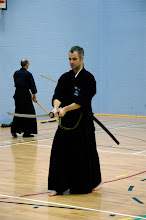
Having had the honour of being invited to lead various iaido and jodo taikai over the last 15 years or so, it came to mind the other day when someone mentioned how nervous they get in taikai, that I always use the same opening speech generally but I've never dedicated the content of that greeting to my most treasured medium - the visual torture of my Shugyo blog, so here it is...

In summary, while it is a useful output of a taikai to learn how to control nerves, going in with no sense of nerves can lead to something of a dull performance. It is suboptimal to dull your nervousness; it is a benefit to overcome and control one's nervousness.
What is there to lose?
If you consider that there can only be one winner in any division in a shiai, in say a taikai with 20 other competitors, the average change of losing is around 95% so if the only reason for coming to a taikai is to win, you may leave the event extremely disappointed. There must be other good reasons for competing in taikai.
This may sounds a bit scandalous but I believe we have an interesting situation in Europe in that the majority of semi-finalists and finalists at 5th and 6th dan level can do better iaido than the majority of the 7th dan judges. I consider myself to be physically inferior to most of the high-grade semi-finalists at the EIC. This isn't a terrible situation to be in; the next generation of judges are being made right now by pushing themselves to be the best competitors they can be. It might have always been like this.
Anyway with this overlap in abilities between judges and competitors, I believe it often means that winning at the EIC can mean the difference of the thickness of a hair in your performance at the semi-finals and finals, perhaps even earlier in the taikai as well. If you want to be certain of winning at the Europeans then you need to be so significantly better than the rest of the competitors that you should probably just quit your job and do budo training 7 days a week. Even there's no guarantee that you won't mess up when it really counts, or that someone else just has a natural talent and kicks your butt. Is it really worth all that worry?
What is there to gain?
I have over the years come to appreciate the rare experience of being nervous in a taikai especially against the rivals who became my good friends and from whom I learned so much from studying. From Claudio Zanoni I learned that being light and sharp could make one's iai look fast and decisive. From Michael Simonini I learned that stability straightness of posture could make one's iai look powerful. I am eternally grateful for having rivals like these around me during my taikai years not to mention, Luc Defraeye, Martin Lindgren and many others.

A bunch of idiots
There is the usual cliche that you only learn from losing; I believe this is mostly true. You can learn from winning a taikai as well but the key to both these outcomes is to reflect on what you did and what happened. Simply cursing the world (and the judges) for losing will yield no good result; continually slapping yourself on the back for winning and doing little else will also yield very little (though the subsequent drinking parties have previously produced the most amazing hangovers).
Kincho - WTF?
緊張 Kincho means nervousness, stress or tension. As well as it's negative-sounding connotations, it also refers to continuous, slight tension as in keeping muscles ready to respond to nerve stimulation as in the word "tonus".
緊 Kin/Shimeru, Shimaru, means to be tense, solid, and reliable
張 Cho/Haru means to stretch or spread
So the two kanji together have a feeling of being kept slightly taut, like a bowstring. This is the kincho that we should embrace and study. How to be kept taut and ready to spring. If we can find a way to turn the kincho of uncontrollable nerves which only makes us freeze or make us uncoordinated and clumsy, into the kincho of being ready to act then this will be a benefit gained clearly from competing in taikai.
In summary, what I am trying to say is that one should enter a taikai with the absolute expectation that one might lose, in fact the odds are stacked against you. Additionally, be aware that the judges are also only human, hence 2-1 results (or only waking up when "hantei" is called). Losing is not the end of your life or dignity.
Now go in with a feeling of wanting to feel those nerves, of being taut and ready to go. Of respecting and even admiring your opponent and wanting to show the best you can alongside them.
Then, when, or if the flags are raised in your favour, bow/handshake/hug/kiss/have babies with your opponent and enjoy the 10-20 seconds of elation before then going on to watch other matches and admire the efforts that others are making to control their own nerves.


 Posts
Posts